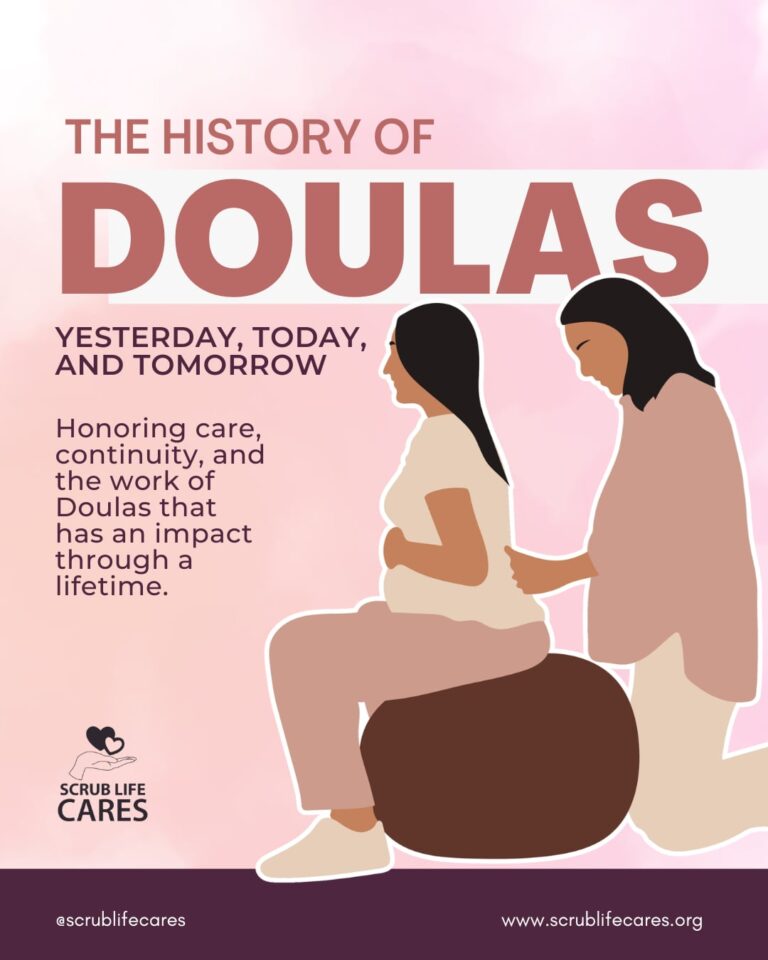
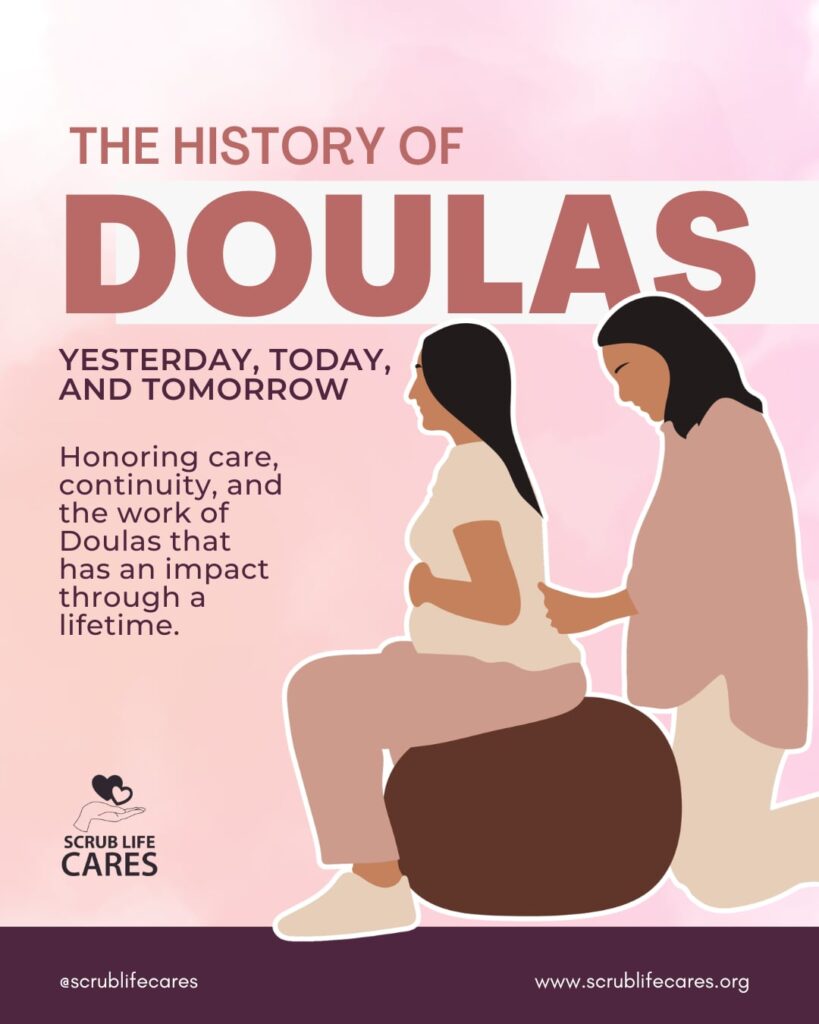
Honoring care, continuity, and the work of doulas that has an impact through a lifetime for World Doula week.
At the end of World Doula Week, we consider all the work that doulas do in the quiet hours when everyone sleeps, resting until they get the call, sitting with women, and holding space. We prefer to recognize doulas beyond what tricks they carry in their bags, but more so what they carry in their hearts to do this work. Doula work is a form of care that has always existed, long before it had a name, a certification, or a place within modern healthcare systems.
The word doula may feel modern and new, but the role is ancient.
To understand where doulas are going, we have to remember what doulas have always been and we can’t discuss that without discussing what women and girls have always needed.
Yesterday: Exploring The Women Who Stayed
Birth has always belonged to women. Before hospitals, charts, visitation policies, and certification boards, birth had a special way of bringing women together in solidarity and support.
Through various cultures and continents, experienced wise women gathered around those on the cusp of shedding matresence. They were mothers, grandmothers, and neighbors carrying raw knowledge that couldn’t be taught from a book, but was learned instead from their bodies and those of others they supported.
There are skills that doulas carry that can be translated all throughout the many experiences women encounter:
- how to sit with a laboring woman in silence
- how to recognize fear before it was spoken
- how to guide a young girl into her first bleeding with respect instead of shame
- how to stay without fixing, tweaking, but just listening
These doulas, otherwise once known as wise women, supported girls through puberty, helped women navigate fertility, stood beside them in labor, and remained through postpartum recovery. Care was continuous in every sense of the word without wavering in relationship and community.
Today: Reclaiming What Was Lost
Modern healthcare has brought life-saving advancements and we can’t discount that medicine has been a beautiful evolution over the decades. Unfortunately it has been responsible for separating women at times, separating women from continuous support.
The healthcare industry is complex between the insurance marketplace, billing, and policies that don’t often reflect the protection of patients, many women navigate with uncetainty and sometimes fear. Rightfully so, many women move through these deeply transformative moments in their lives that are often under-supported. We’re missing a huge gap in opportunity to improve the future of women’s health with simply providing unwavering support.
We can see now that doulas are becoming more recognized for the outcomes they produce in a birth setting. Medical birth settings are catching up to what women have known for centuries.
A doula now may:
- Provide emotional and physical support during pregnancy and labor
- Offer evidence-based education so women can make informed decisions
- Support postpartum recovery and maternal mental health
- Act as a steady, familiar presence within clinical settings
Research continues to show that doula support is associated with improved birth outcomes, increased patient satisfaction, and reduced intervention rates, but we never needed the research to prove what women already knew.
Aside from the data, doulas are helping women feel seen, heard, and cared for again.
Doula Work as Longevity Support
We understand what doula work was and is, but can we see them and utilize their work on a deeper level, seeing them as someone who not only supports someone during birth, but prior to and long after the birth experience? Doulas can be someone who walks alongside a girl as she becomes a woman.
The need for support in womanhood doesn’t just begin at the onset of labor, it begins long before.
Supporting Girls Through Puberty
Puberty is often a girl’s first experience of confusion around her body and while it’s something all humans will experience moving through phases of growth and development, there is still missed opportunity here.
There are spaces where puberty and menstruation are marked by shame, misinformation, or embarrassment. Many girls are going the distance of puberty, this powerfully deep biological transformation, alone when this is one that deserves competent care from others that’ve gone before them.
If we explored what it would mean to “doula” a young girl through puberty could look like:
- Teaching her to understand her menstrual cycle as a sign of health
- Offering accurate, age-appropriate body literacy education
- Creating space for questions without shame
- Helping her build trust in her body early on
- Helping her understand patterns of fertility and infertility
This is women’s preventative care in its simplest most effective form.
When a girl understands her body, she enters womanhood with a different foundation, a confident, body literate person, one rooted in awareness instead of disconnection.
Supporting Postpartum and Beyond
Historically, postpartum care has been congruent with maternal and child care, but today, we see postpartum compartmentalized to a fault. One visit 6-8 weeks after birth and then we dismiss a new mother with her new baby and it’s on to the next.
Today, a culture of production and output has many mothers expected to return quickly to daily life, often without adequate support mentally, emotionally, or physically.
Doulas are helping to break this cycle through different areas of support:
- Supporting physical and emotional recovery
- Offering guidance in newborn care and feeding
- Screening for signs of maternal mental health challenges
- Helping mothers integrate their birth experience
Without rushing the ease back into societal expectations, we can make sure that women are coming back on their own terms and encouraged to pivot if it’s what they need.
Tomorrow: Expanding the Definition of Care
The future of doula work is growing, not just expanding, but deepening as well. Doulas are getting connected with organizations that are committed to helping young girls grow into body literate women.
Doulas have the unique opportunity to support:
- Community-based programs that support girls before they become patients
- Integration of doulas into healthcare systems as essential members of the care team
- Increased access for underserved and marginalized communities
- A broader understanding of care that translates to the full reproductive lifecycle
Organizations like Scrub Life Cares are uniquely positioned to lead this work. By investing in education, mentorship, and community-based support, we see the support and care become reimagined for women, in and out of moments of crisis, not reactive, but responsive.
At its core, doula work is community work that offers multi-generation support. From her first cycle, to her first birth, postpartum experience, mothering journey, a presence of solid support that is informed and compassionate will last a woman’s lifetime. In turn, she can offer that same support in different capacities and we break generation trauma one woman at a time.
As we honor World Doula Week, we are not just celebrating a profession, we are recognizing a deeper lineage of care that has always existed, carrying it forward into a massive legacy for women everywhere.